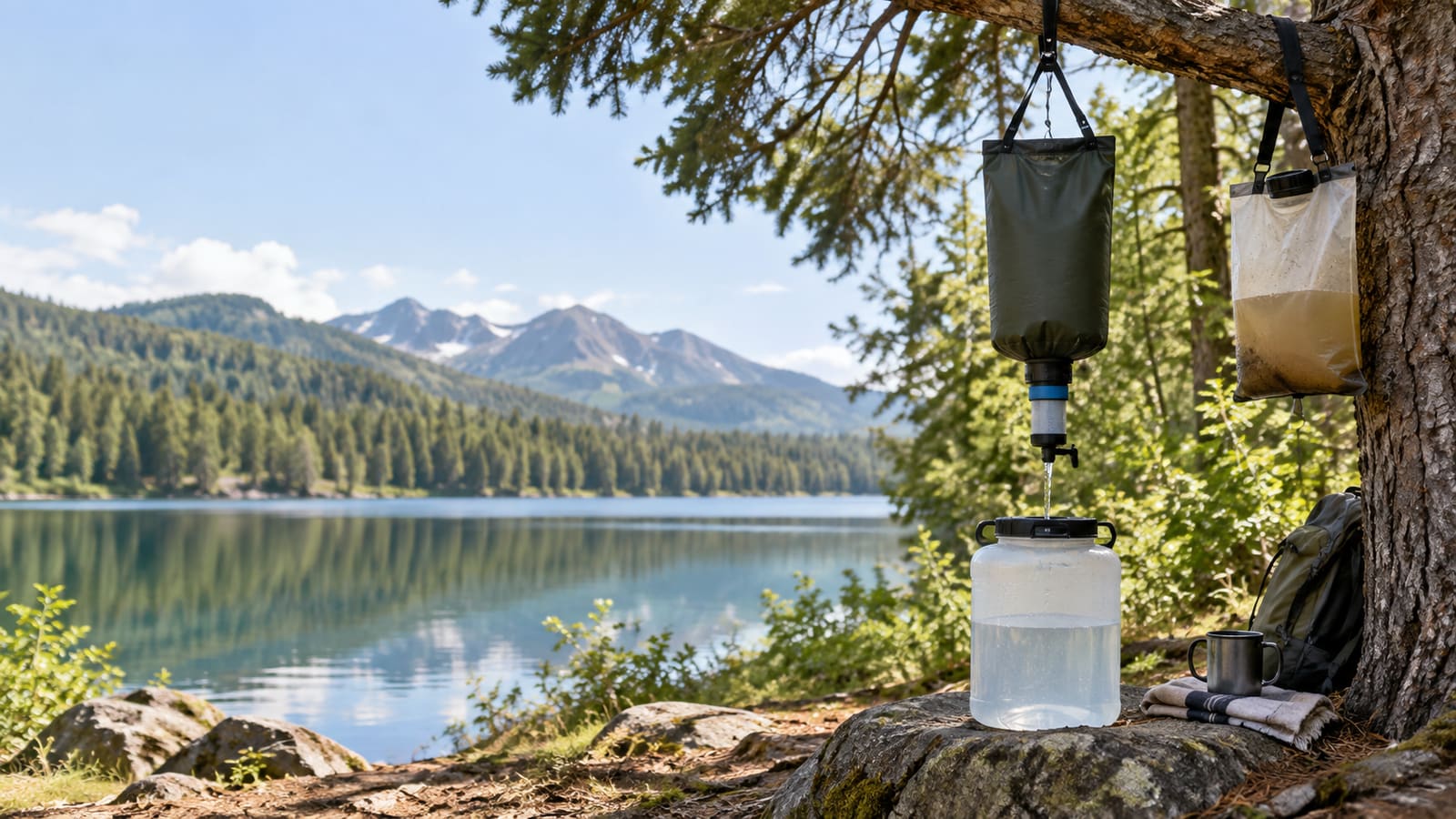
A water filter is one of the most popular pieces of survival equipment. It's also one of the easiest pieces of equipment to misunderstand. People often use words such as filter, purifier, treatment and disinfection as if they all mean exactly the same thing. They don't.
That matters because a device can make water look dramatically cleaner without necessarily addressing every hazard that could make that water unsafe. The most useful question isn't "is this a good filter?" It's "what exactly is this product designed to remove?" That is the question every preparedness buyer should learn to ask.
Start With Stored Water
Before discussing filtration, begin with something simpler. Your emergency water plan should start with safe stored water. CDC currently recommends storing at least one gallon of water per person per day for three days and trying to build toward a two-week supply where practical.
A filter is a backup capability. It does not create a water source. If your tap stops working and there is no appropriate source nearby, a filter has nothing to filter. Think in this order: store safe water first, add treatment capability second. That mindset prevents one of the most common mistakes in preparedness.
What Does Water Filtration Do?
A filter physically removes things from water as the water passes through some type of barrier or media. Depending on the filter, that may include sediment, parasites, bacteria or certain chemicals. But filters are not all the same.
CDC notes that portable filters do not remove all types of germs. In particular, common portable filters should not be assumed to remove viruses. CDC advises checking the filter's specifications and following its instructions exactly.
That means the word filter tells you very little by itself. You need the specifications. A filter designed mainly for sediment is different from one designed to remove certain microorganisms. And neither should automatically be assumed to remove fuel, pesticides, heavy metals or other chemical contamination. Different problems require different treatment.
Filtration vs. Purification
Filtration
- Removes sediment, parasites
- May remove bacteria
- Does not remove viruses
Purification / Disinfection
- Boiling, chemical, UV
- Targets viruses & germs
- Needs clear water first
What Does "Purification" Mean?
This is where the language gets confusing. Manufacturers sometimes use purifier to describe a product capable of addressing a broader range of biological hazards than a basic filter. But don't buy based on the word printed in large letters on the box. Read the actual performance claims.
CDC's guidance is more useful because it separates treatment methods by what they do: filtration, boiling, chemical disinfection and ultraviolet treatment each have different strengths and limitations. For preparedness purposes, think of water treatment as the larger category. Then ask what specific method — or combination of methods — is appropriate for the hazard you are dealing with.
Filters and Viruses
This deserves special attention. CDC states that portable water filters do not remove viruses. It recommends additional disinfection after filtering when virus contamination is a concern.
That's why someone traveling internationally, responding to flooding or using water in a heavily impacted disaster environment may face different treatment considerations from a backpacker filtering clear mountain water. The product has to match the problem. Never assume that clear-looking water is biologically safe. And never assume that because one type of filter works well in one environment, it is appropriate for every emergency.
Boiling
When the concern is harmful germs, CDC describes boiling as the best way to kill germs in water. Its current emergency guidance calls for bringing clear water to a rolling boil for one minute, or three minutes above 6,500 feet, then allowing it to cool in a clean container.
Boiling has an important limitation, however: it requires fuel or electricity. That's why a good preparedness system should not rely on one method alone. You may have a filter. You may have treatment tablets. You may have the ability to boil. You also have stored water. That's redundancy.
Chemical Disinfection
Chemical disinfectants can kill many disease-causing organisms, but the effectiveness depends on the chemical, organism, concentration, water condition and contact time. CDC notes that chemical disinfectants do not all work equally well against every parasite. This is another reason to follow current official guidance and the specific product instructions rather than improvising concentrations. More chemical is not automatically safer.
Layered Water Treatment
UV Treatment
Portable ultraviolet systems can kill germs in small quantities of clear water. But cloudy water creates a problem because particles can shield microorganisms from the light. CDC therefore recommends clarifying or filtering cloudy water before UV treatment and following the UV device instructions. Again, every method has conditions under which it works best.
What About Chemicals, Fuel or Radioactive Contamination?
This is where the idea of one magical "survival filter" becomes especially dangerous. CDC explicitly warns that water contaminated with fuels, toxic chemicals or radioactive materials cannot be made safe simply by boiling or ordinary disinfection. If authorities tell you a source may contain chemical contamination, use a safe alternate source and follow local public-health instructions. Don't experiment.
A Better Emergency Water System
Instead of asking "which filter should I buy?", build your water preparedness in layers. Your first layer is safe stored water. Your second is a portable treatment option appropriate for the situations you're preparing for. Your third is another treatment method or reserve if the first is unsuitable or fails. Your fourth is knowledge: knowing what your equipment actually removes. That final layer costs nothing. And it may be the most important one.
Before Buying a Water Filter
Look for clear answers to these questions:
- What organisms or contaminants is the product designed to address?
- Does it remove parasites? Bacteria? Does it address viruses?
- Does it make any validated chemical-reduction claims?
- How much water can it treat, and how quickly?
- What maintenance does it require?
- What happens if it freezes?
- What replacement components are required?
- What water sources is it intended for?
If those answers aren't clear, don't let the word "survival" on the packaging make the decision for you.
The Bottom Line
Filtration is a tool. It is not your entire water plan. Start by storing safe water. Then choose treatment methods based on the actual hazards you may encounter. Understand what your equipment removes. Understand what it does not remove. And whenever public authorities issue a drinking-water advisory, follow their instructions.