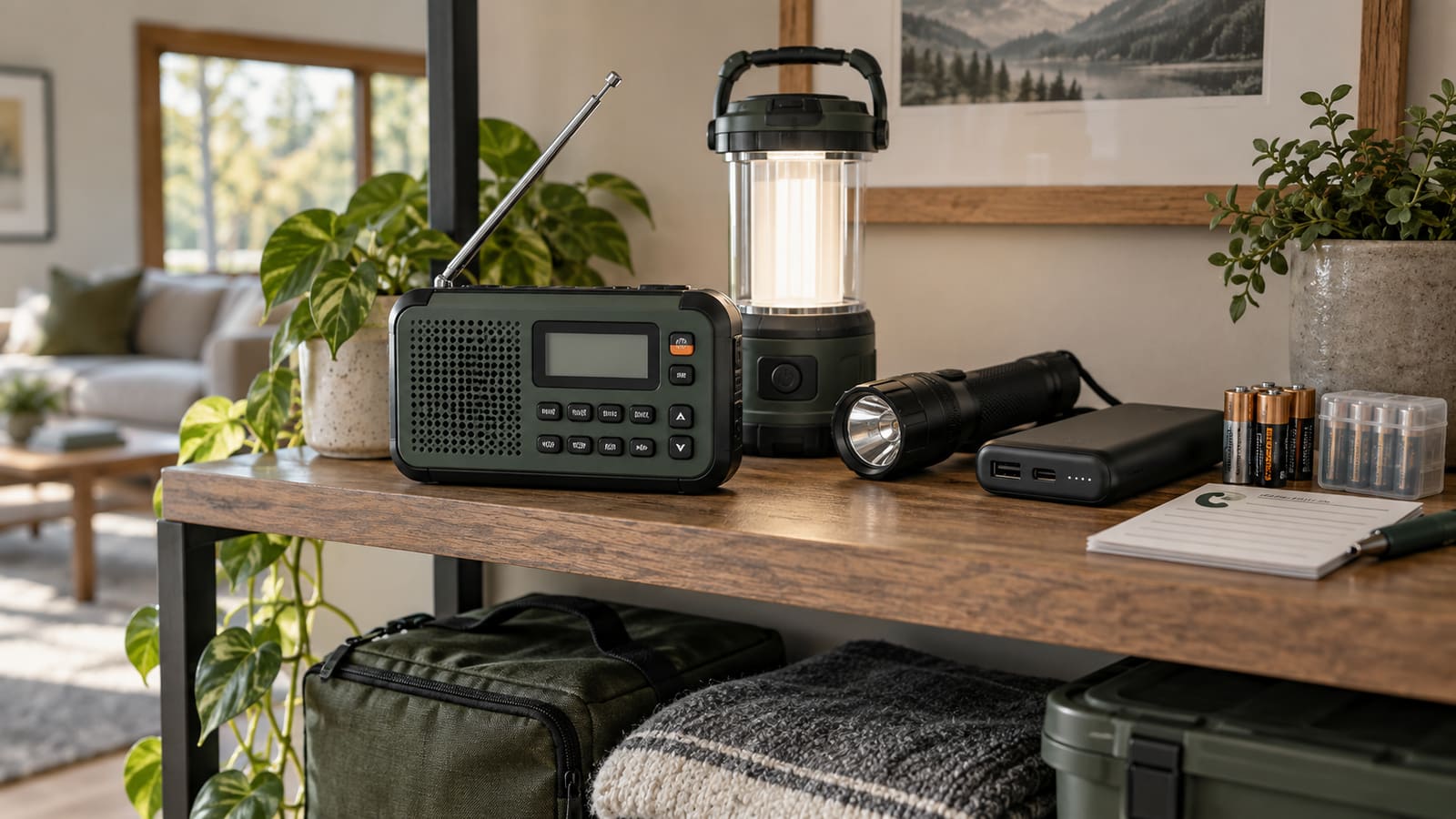
Most people already carry an extraordinary emergency communication device: their phone. So why would you need a radio? Because your phone depends on other systems — a working battery, cellular infrastructure, internet access, charging. Emergency preparedness works better when one failure doesn't remove every option.
An emergency radio gives you another way to receive important information. And in the United States, the feature you should understand first is NOAA Weather Radio All Hazards.
What Is NOAA Weather Radio?
NOAA Weather Radio All Hazards is a nationwide National Weather Service network that broadcasts official warnings, watches, forecasts and other hazard information around the clock. It also carries information about certain non-weather hazards. National Weather Service sources report that NOAA Weather Radio reaches roughly 97% of the U.S. population through more than 1,000 transmitters.
It isn't an ordinary AM/FM station. You need a receiver capable of tuning NOAA's dedicated weather-radio frequencies. For a preparedness radio in the United States, NOAA capability should be high on the list.
Receiving Weather Is Different From Receiving Alerts
A basic weather radio may allow you to manually tune in and listen. An alert-capable weather radio can monitor for special emergency tones and activate when warnings are issued. That difference matters at night or when you aren't actively listening. The National Weather Service recommends radios with an alarm feature and battery backup for warning reception. For home preparedness, an alerting receiver is usually more valuable than a device you have to remember to turn on every time the weather changes.
What Is SAME?
SAME stands for Specific Area Message Encoding. Compatible weather radios can be programmed to respond to alerts for selected geographic areas. That can reduce unwanted alarms for distant counties while preserving warnings relevant to you. National Weather Service guidance notes that SAME-capable receivers allow users to select warning areas and can trigger automatically for qualifying alerts. For a dedicated home radio, SAME is a feature worth considering.
NOAA Weather Radio Reach
population reached
nationwide
Battery Backup Matters More Than Fancy Features
An emergency radio that works only from a wall outlet stops being very useful when the wall outlet stops working. Look for reliable battery operation. Rechargeable internal batteries can be convenient. Replaceable batteries can add useful redundancy. The best setup often provides more than one power method.
But understand what those methods actually do. A small solar panel or hand crank can be valuable for emergency charging, but don't assume either one will effortlessly replace normal electrical charging. Keep the radio charged before the emergency.
What About Hand-Crank Radios?
Hand cranks are useful because they provide a way to generate some power manually. That can be helpful if batteries are exhausted and normal charging isn't available. But a hand crank should be treated as a backup, not an excuse to ignore battery management. Charge the radio normally. Keep appropriate batteries available if the model accepts them. Use the crank when you need redundancy. That's a more realistic system.
AM/FM Is Still Useful
NOAA is excellent for official hazard information. AM/FM can provide local news and information from broadcasters. A radio that includes both NOAA and ordinary broadcast reception may therefore offer useful flexibility. During a widespread emergency, local stations may carry road closures, shelter information and community-specific updates. Again, redundancy.
NOAA vs. AM/FM
NOAA Weather Radio
- Official hazard alerts
- Automatic warning tones
- 24/7 broadcasts
AM/FM
- Local news & updates
- Road closures
- Community information
Built-In Flashlight: Useful, But Secondary
Many emergency radios include flashlights. There's nothing wrong with that. But your radio should not be your household's only flashlight. If everyone is carrying the radio around for illumination, nobody can leave it positioned for good reception. Keep lighting and communication as separate systems with some overlap — not one device doing everything.
Phone Charging Is a Bonus
Some emergency radios can provide USB charging. This can be useful. But the internal battery is usually far smaller than a dedicated power bank. Treat emergency phone charging as an additional capability rather than the main reason to buy the radio. If phone runtime matters, keep a charged power bank too.
Reception Matters
NOAA Weather Radio reception depends on transmitter distance, terrain, receiver quality and placement. That means you should test your radio where you actually live. Don't wait for a tornado warning to discover that your preferred shelf is a terrible reception location. Extend the antenna. Test different parts of the house. Program SAME codes if applicable. Learn the controls.
Accessibility Features
Emergency alerts should work for everyone in the household. The National Weather Service notes that some NOAA receivers can support visual alerts, vibrating devices, bed shakers and text displays for people who are deaf or hard of hearing. If someone in your household has hearing, vision or mobility needs, include those needs in the equipment decision. Preparedness shouldn't assume one type of user.
What I Would Look For
A practical household emergency radio should provide dependable NOAA Weather Radio reception, warning alerts, battery backup and easy controls. After that, prioritize features according to your needs: SAME programming, AM/FM reception, rechargeable power, replaceable batteries, hand-crank backup, solar trickle charging, flashlight and limited device charging. Don't buy based on the longest feature list. Buy based on the features you will actually maintain and use.
Test It
When you bring the radio home: set it up, find your NOAA station, program your alert area if necessary, check reception, learn how to change power sources, charge the battery, and show another household member how it works. Then test it again periodically. An emergency radio should not remain sealed in the box until the emergency begins.
The Bottom Line
An emergency radio solves one important problem: it gives you another way to receive information when normal systems are unreliable. That's why it belongs in a broader communication plan containing phone alerts, backup charging, written contacts and a household plan. One radio isn't preparedness. It's one layer.